Covered Calls
Learn how to sell covered calls against your stock positions to generate premium income. Track assignments, calculate yields, and manage your positions effectively.
Covered calls are a popular income-generating strategy where you sell call options against stock you already own. Option Tracker makes it easy to track these trades and link them to your underlying positions.
What is a Covered Call?
A covered call involves:
- Owning stock (at least 100 shares per contract)
- Selling a call option at a strike price above current price
- Collecting premium as immediate income
- Obligation to sell if the stock reaches the strike price
Why Sell Covered Calls?
- Generate income on stocks you already own
- Lower cost basis of your position
- Define an exit price you're happy to sell at
- Profit in flat markets when the stock doesn't move much
Selling a Covered Call
From the Stocks page, find the position you want to write a call against.
Step 1: Open the Action Menu
Click the three-dot menu on your stock position.
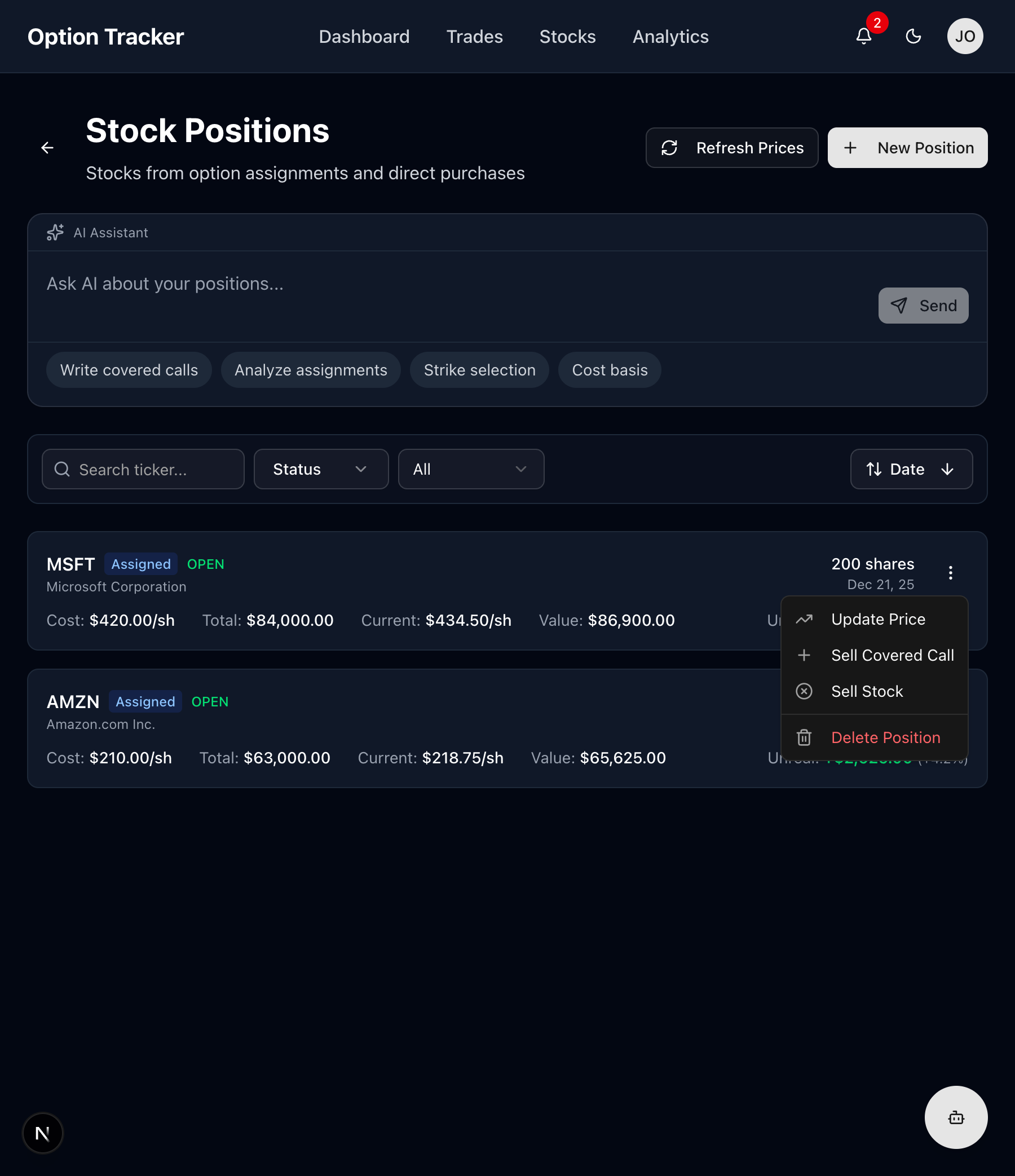
Step 2: Select "Sell Covered Call"
This opens the covered call form pre-filled with your position details.
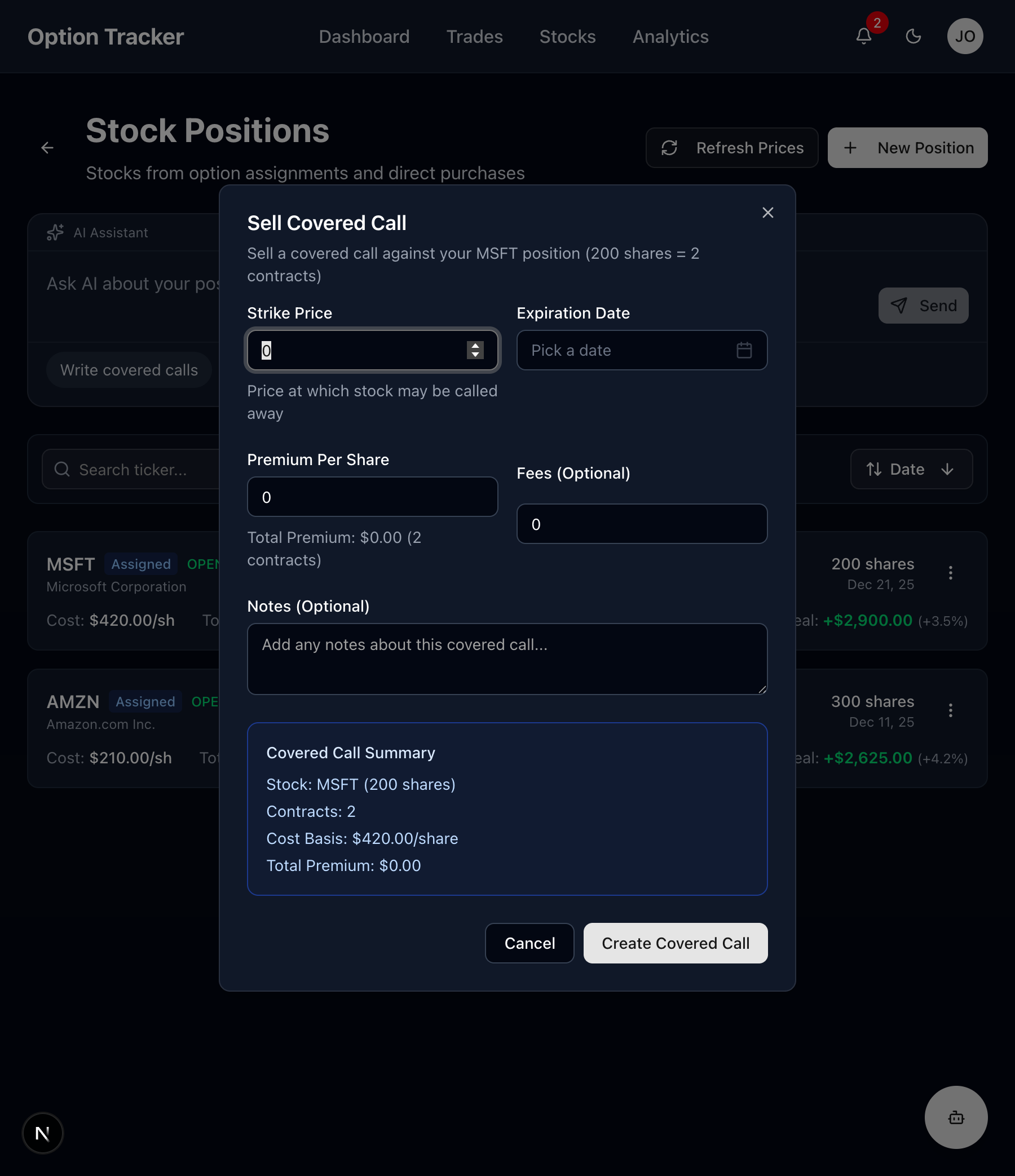
Step 3: Enter Call Details
-
Strike Price - The price at which you agree to sell your shares
- Choose above current price for best results
- Higher strike = less premium but less likely to be called
-
Expiration Date - When the option expires
- 30-45 days is common (optimal time decay)
- Weekly options for more frequent income
-
Premium Per Share - What you receive per share
- System calculates total: Premium × Contracts × 100
-
Fees (Optional) - Broker commissions
-
Notes (Optional) - Strategy notes, target profit, etc.
Step 4: Review Summary
The Covered Call Summary shows:
- Stock being covered (ticker and shares)
- Number of contracts (shares ÷ 100)
- Your cost basis for reference
- Total premium you'll receive
Step 5: Create the Call
Click "Create Covered Call" to record the trade.
Understanding the Numbers
Maximum Contracts
You can sell 1 call contract per 100 shares owned:
| Shares Owned | Max Contracts | |--------------|---------------| | 100 | 1 | | 200 | 2 | | 500 | 5 | | 1000 | 10 |
Premium Calculation
Total Premium = Premium per Share × Contracts × 100
Example:
- Own 300 shares of AAPL
- Sell 3 calls at $2.50 premium
- Total premium: $2.50 × 3 × 100 = $750
Break-Even with Covered Call
Break-Even = Cost Basis - Premium Received per Share
Example:
- Cost basis: $150/share
- Received: $2.50 premium
- New break-even: $147.50/share
Managing Covered Calls
Once created, covered calls appear in your Trades list linked to the stock position.
Possible Outcomes
-
Expires Worthless (Stock below strike)
- Keep all premium
- Keep your shares
- Can sell another call
-
Called Away (Stock above strike at expiration)
- Shares sold at strike price
- Keep the premium
- Stock position closed
-
Buy to Close (Close early)
- Pay to close the position
- Keep shares
- Realize partial profit/loss
Tracking Linked Positions
Option Tracker links covered calls to their underlying stock:
- View covered call status from stock position
- See combined P&L (stock + call premium)
- Track multiple rounds of covered calls
Covered Call Strategies
Conservative (Deep Out-of-the-Money)
- Strike 10-15% above current price
- Lower premium, lower chance of assignment
- Best when you want to keep shares long-term
Moderate (Slightly Out-of-the-Money)
- Strike 3-5% above current price
- Balanced premium and assignment risk
- Common for income investors
Aggressive (At-the-Money)
- Strike near current price
- Higher premium, higher assignment risk
- Best when willing to sell at current prices
Rolling Covered Calls
When a call is about to be assigned but you want to keep shares:
- Buy to close the current call
- Sell to open a new call at:
- Same or higher strike
- Later expiration
- Ideally collect net credit
This is called "rolling up and out."
AI Assistant for Covered Calls
The stocks page AI can help with:
- Strike selection - Optimal strikes for your risk tolerance
- Premium analysis - Expected returns at different strikes
- Roll timing - When to roll vs. take assignment
Best Practices
-
Only sell calls on stock you'd sell - Be comfortable with assignment
-
Start with 30-45 DTE - Optimal time decay (theta)
-
Target 1-2% monthly - Reasonable income expectation
-
Watch earnings - Avoid selling calls through earnings if bullish
-
Have an exit plan - Know when you'll roll or take assignment
-
Track your cost basis - Premium lowers your effective cost
Example: Complete Wheel Cycle
Here's how covered calls fit into the wheel strategy:
-
Sell Cash-Secured Put ($150 strike, $3 premium)
- Stock at $155, put expires worthless
- Profit: $300 (kept premium)
-
Sell Another Put ($150 strike, $2.50 premium)
- Stock drops to $148, assigned at $150
- Cost basis: $150 - $2.50 = $147.50
-
Sell Covered Call ($155 strike, $2 premium)
- Stock rises to $156, called away
- Profit: ($155 - $147.50) × 100 + $200 = $950
Total profit from cycle: $300 + $950 = $1,250